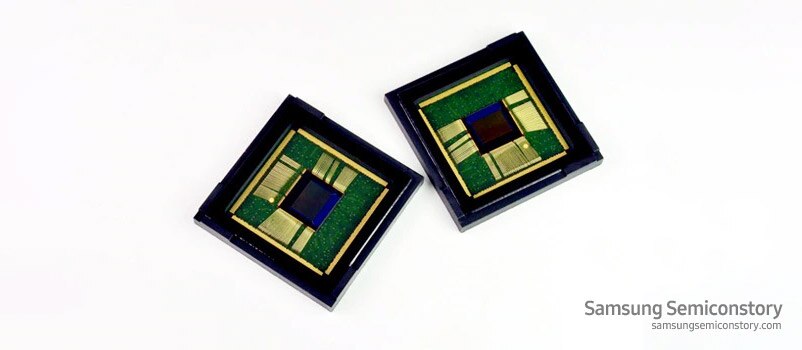
▲ An 8 megapixel (1/4 inch) module using the next-generation ‘ISOCELL’ CMOS image sensor technology
First, let’s go over the terminologies to grasp the concept of CIS.※ I.C., Integrated Circuit – A functional element with a complete circuit. A multiplicity of active elements (e.g. transistors) and passive elements (e.g. diodes, condensers, resistors, etc.) are integrated at nano-scale onto a single semiconductor substrate, forming one inseparable structure. ※ CMOS (Complementary Metal-Oxide Semiconductor) – A complementary metal-oxide semiconductor is characterized by extremely low power consumption, and is widely used in portable calculators, electronic watches and clocks, small computers and more.
CIS is an image sensor fabricated using the CMOS technology. It is an integrated circuit on which a countless number of light-sensitive pixel sensors are arranged. Each pixel consists of a photodetector, which detects light, and an active amplifier which amplifies a signal. Given that CIS receives light and converts it into electric signals, CIS is a key component that determines the quality of an image. CMOS image sensors are widely used in digital imaging devices. Examples include digital cameras, smartphones, tablets, and other communication devices. ■ ISOCELL: Innovative evolution of the sensor structure ISOCELL is an innovative technology which modifies the sensor structure to maximize the use of light entering the pixels making up the CIS. ‘ISO’ from ‘isolate’ is combined with the word ‘cell’. As the name suggests, each pixel is isolated by a physical wall, just like a cell. This reduces cross-pixel interference. This way, clearer and more vivid images can be obtained even in low-light settings. The pixel technologies of the CIS can be categorized as FSI (Front Side Illumination) or BSI (Back Side Illumination). By flipping the silicon wafer during manufacturing and then thinning its reverse side, BSI allows light to be received from the rear of a pixel. This reduces the distance of light coming through the pixel, and increases the amount of light entering. This increases the sensitivity by more than 40% compared to FSI, and helps improve the image quality.※ Wafer – A thin disc used in manufacturing integrated circuits. Made up of silicon crystals with a diameter of 5 to 10cm.
However, BSI has a disadvantage– a large amount of light and color is absorbed, resulting in the mixing of colors of neighboring pixels.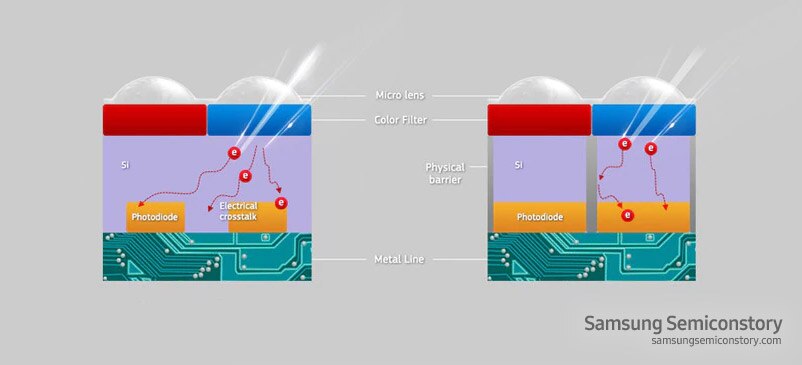
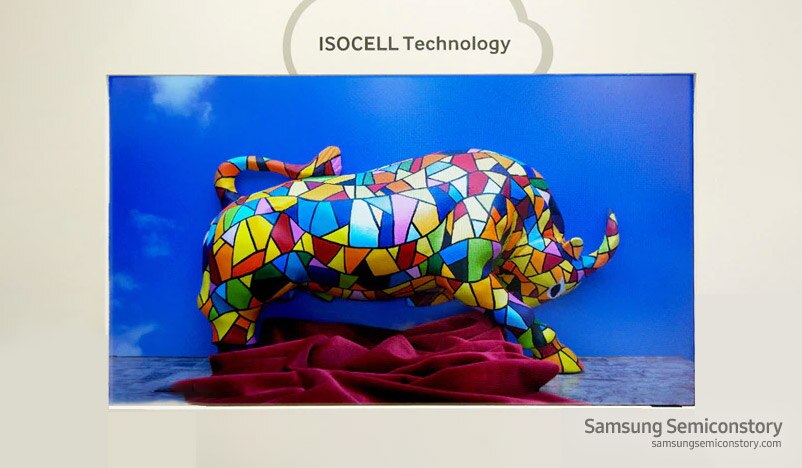
※ FWC, Full Well Capacity – The amount of light received by a pixel in a sensor. The greater the area is, the more light is received and the better quality of images is produced.
CIS and ISOCELL are handy technologies which allow us to capture and remember those precious moments in life. That’s Samsung Electronics’ semiconductor innovation at work to help keep our digital memories vivid and unfaded.

 中国
中国